Technical Protocols for Precision Structural Drying and Thermodynamic Stabilization in Pittsburgh
Following the successful completion of initial bulk water extraction, the primary objective of a professional restoration protocol is the systematic reduction of moisture content within building assemblies to levels that preclude secondary structural decay. When a residential property experiences a significant water intrusion event, standard evaporation rates are insufficient to counteract the moisture deeply absorbed by porous construction materials. Left unmanaged, saturated components—including structural floor framing plates, internal wall insulation sheets, sub-flooring plywood, and concrete masonry foundations—act as deep-seated reservoirs for latent moisture.
This trapped liquid initiates a rapid degradation cycle characterized by material swelling, loss of compressive strength in wooden members, and accelerated microbial proliferation within the building envelope. Without a rigorous, scientifically-validated thermodynamic intervention, properties throughout Pennsylvania face severe long-term structural risks, including extensive dry rot, systemic mold colonization, and compromised foundation stability that can permanently devalue the real estate asset. Our objective is to restore the building envelope to a dry, stable baseline through controlled, high-capacity dehumidification.
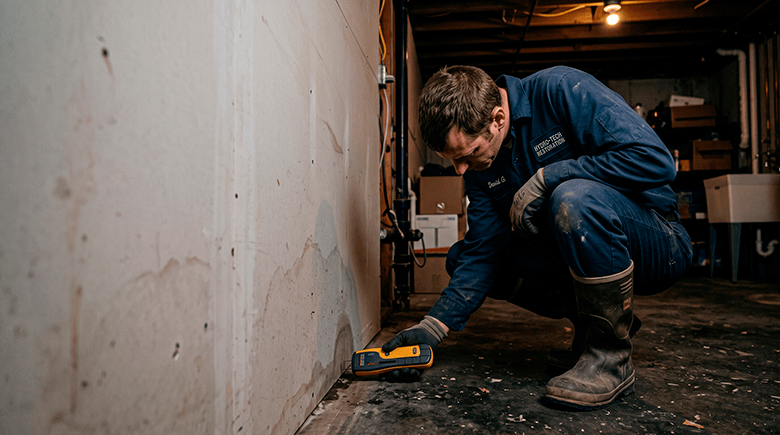 Advanced moisture mapping utilized to monitor material dryness during the critical restoration phase in Pennsylvania residential zones.
Psychrometric Balancing and Advanced Humidity Control
Structural drying is fundamentally a complex psychrometric process—the exact science of managing the dynamic relationship between air temperature, relative humidity, and the dew point. To successfully stabilize a structure after a major flood, restoration teams must aggressively lower the ambient vapor pressure within the affected environment, thereby forcing an accelerated rate of evaporation from saturated structural materials. This process necessitates the continuous, high-duty-cycle operation of Low-Grain Refrigerant (LGR) dehumidifiers specifically engineered to extract maximum moisture volume from the internal air stream even in low-humidity conditions.
By continuously monitoring the grains per pound (GPP) of the indoor air, our technicians verify that the evaporation loop is optimized for rapid material moisture reduction. This precise control is essential for preventing the secondary damage to delicate interior finishes, electronic components, and structural framing members in Allegheny County properties, where fluctuating seasonal humidity levels can often impede natural drying cycles and create micro-climates conducive to fungal growth. We maintain GPP standards to ensure the drying air is always thirsty for moisture, pulling vapors directly from the building's core rather than simply recycling saturated air.
Industrial Air Movement and Boundary Layer Control
Efficient structural evaporation requires more than simple dehumidification; it necessitates the application of high-velocity air movement to disrupt the stagnant boundary layer of moisture surrounding saturated surfaces. We deploy professional-grade axial and centrifugal air movers designed to create a turbulent airflow pattern that forces the transition of liquid moisture into a gaseous vapor state. This mechanical process is meticulously optimized through strategic equipment placement to ensure uniform, high-pressure airflow across all affected framing, wall cavities, and subfloor assemblies.
By maintaining constant volumetric air circulation, we ensure that moisture is pulled from the deepest pores of the construction materials, preventing the formation of stagnant humidity pockets that often lead to localized structural failure if left unaddressed. Proper air movement creates the necessary energy to lift water molecules out of dense wood and concrete structures effectively. Our technicians assess the surface area of the affected space and apply a specific cubic-feet-per-minute (CFM) ratio to ensure that every square inch of the structure receives the required airflow intensity to promote rapid drying.
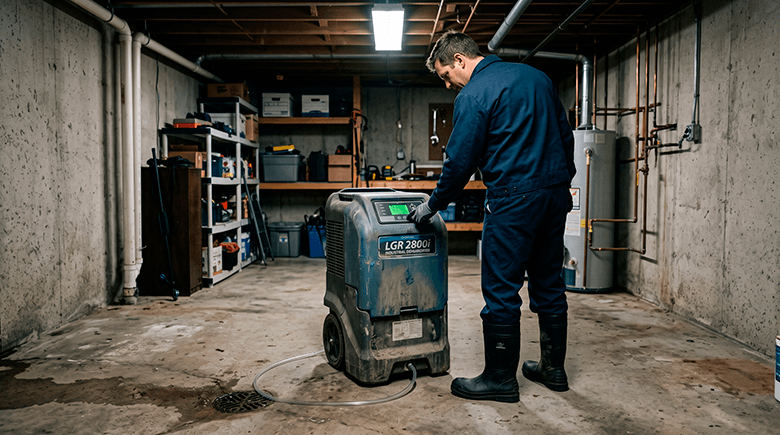 Industrial LGR dehumidification systems deployed to manage ambient humidity during the structural drying cycle.
Verification of Dry Standards and Technical Documentation
A water damage restoration project is technically complete only when all affected structural materials reach a target moisture content verified by calibrated, industry-standard diagnostic equipment. Our field teams maintain exhaustive, timestamped daily dry logs, meticulously tracking the cumulative reduction in moisture percentages within wood sills, sub-flooring, and masonry components. This data-driven, auditable approach is absolutely critical for justifying restoration costs to national insurance adjusters and ensuring that no hidden moisture remains within the building envelope to cause future rot or health hazards.
For high-intent property owners in Allegheny County, providing this level of audit-ready technical documentation is the most effective, verified way to eliminate protracted coverage disputes and guarantee the long-term success of the project. Each restoration file is compiled to include detailed psychrometric charts, daily progress reports, and thermal imaging diagnostics, providing the definitive, verifiable proof that the structure has been fully returned to safe, industry-certified, and stable conditions. We bridge the gap between mitigation and insurance approval through total transparency and technical precision.
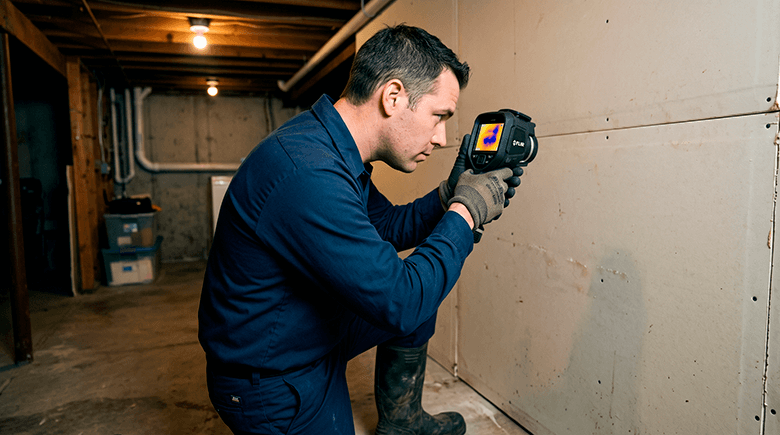 Professional thermal imaging inspection used to document and verify the total elimination of trapped moisture within wall cavities and structural framing.
Mitigating Long-Term Structural Risk
The long-term health of your home depends on how you handle the immediate aftermath of a water intrusion event. In the Pittsburgh metro area, where climate fluctuations and groundwater tables can create recurring moisture problems, relying on professional structural drying is the only way to avoid the cycle of repeated repairs. Our approach integrates state-of-the-art diagnostic technology with proven thermodynamic principles to restore the property to pre-loss condition or better.
By neutralizing the threat of mold, preventing structural rot in load-bearing members, and ensuring a dry, healthy indoor air quality environment, we provide peace of mind to homeowners who have faced the stress of unexpected water damage. We are not just drying floors; we are preserving the structural life of the building itself, ensuring that your home remains a safe and valuable asset for years to come. Through constant monitoring, strategic equipment cycling, and rigorous adherence to industry drying standards, we ensure that the restoration process is both efficient and thorough.