The Technical Mechanics of High-Volume Emergency Water Extraction
When a residential property suffers a major water breach, immediate fluid evacuation is a critical emergency intervention required to prevent long-term structural failure. Standing water spreads rapidly through porous construction assemblies via intense capillary action, soaking floor framing plates, internal insulation sheets, and concrete structures. Basement wall cracking and foundation settling in homes necessitate immediate water extraction to prevent irreversible damage. Persistent subsurface water tables exert hydrostatic pressure that forces liquid through porous concrete masonry units, a common failure point for Pennsylvania residential infrastructure.
We specialize in clearing standing floodwater in crawl spaces and sub-slab saturation throughout the Pittsburg metro area, preventing the long-term structural degradation caused by trapped moisture. Using industrial-grade CFM air movement, we perform a deep-pore extraction that far exceeds standard basement pump-out methods. By neutralizing the moisture content in concrete slab subfloors, we prevent the "wicking" effect that pulls water up into your home’s wooden framing and insulation, halting horizontal fluid migration and significantly reducing total drying costs.
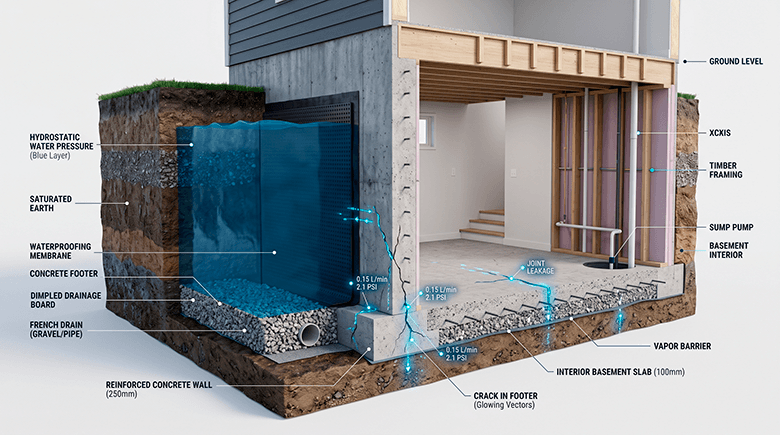 Mechanical blueprint illustrating subsurface water tables causing immediate basement inundation and foundational degradation during severe storm events.
Machinery Standards for Property Mitigation
Choosing the correct water extraction equipment depends heavily on fluid depth and total water volume. For severe structural flooding, dispatched crews initially deploy heavy-duty submersible pumps. Running on portable generators, these rugged industrial units bypass heavy solids and thick sediment, pumping out thousands of gallons of standing water per hour through large-diameter discharge lines to clear the bulk volume quickly.
Once standing water levels fall below two inches, technicians transition to high-vacuum truck-mounted extraction systems. Operating directly off a commercial work van's high-horsepower engine, these truck-mounts deliver massive suction through flexible, wire-reinforced hoses. The intense static lift pulls trapped moisture completely out of dense flooring layers far better than lightweight portable tools. This deep fluid extraction minimizes subsurface saturation, setting a clean baseline for the secondary structural drying phase required to prevent foundation efflorescence.
Advanced Fluid Diagnostics for Structural Integrity
Removing visible surface fluid is only the first step in a professional water extraction protocol. Saturated subfloors and interior wall cavities retain massive quantities of hidden moisture that cause rapid material rot and toxic mold growth if ignored. To trace exactly where water has migrated, restoration specialists deploy advanced diagnostic tools, including non-invasive digital moisture meters, pin-type structural meters, and high-resolution infrared thermal imaging cameras. These tools allow for the precise mapping of water migration paths, identifying hidden moisture pockets behind finished drywall without destroying structurally sound materials.
Infrared thermal imaging cameras locate hidden water tracking paths by documenting distinct temperature drops caused by active subsurface evaporation. Specialists drive pin meters deep into hidden wood framing plates and sills to establish exact moisture content percentages, mapping out a precise structural baseline required to verify industry dry standards in Allegheny County properties.
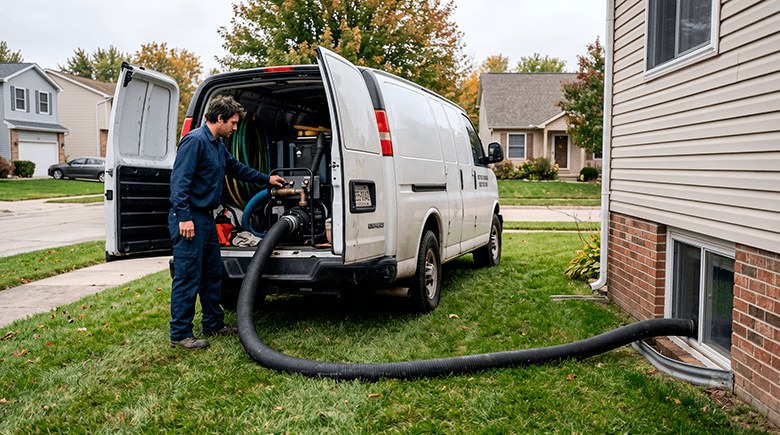 High-capacity truck-mounted vacuum systems pull thousands of gallons of standing water directly from building subfloors into specialized vehicle holding tanks.
Logistical Infrastructure: Regional Fleet Response Nodes
Maintaining a dependable, rapid-deployment network across the Allegheny County region requires a robust logistical framework. The independent field contractors in our database do not operate out of administrative offices or empty store lots. Instead, commercial truck-mounted fleets and high-capacity water extraction machinery are housed, maintained, and loaded inside massive regional staging warehouses located right near critical highway corridors.
These industrial storage depots keep extensive stockpiles of high-volume extraction gear fully prepped for immediate field release. Maintaining active equipment readiness at multiple distribution hubs allows on-duty field teams to board fully loaded white commercial vans and hit the road within minutes. This streamlined operational loop cuts response times down to the absolute minimum, delivering heavy-duty commercial pumping assets right to the property when every minute counts.
- Urban Core Logistics: Positioned for immediate dispatch to high-density commercial centers and business districts.
- River Valley Depots: Optimally situated to provide fast response times across lower river basins and sprawling residential neighborhoods.
- Regional Fleet Hubs: Focused on delivering rapid extraction support to remote perimeter communities and industrial warehousing zones.
Thermodynamic Evaporation and Environmental Humidity Control
Immediately after bulk fluid extraction is complete, technicians must address remaining subsurface moisture using a controlled thermodynamic drying loop. Left unmanaged, high indoor humidity levels cause secondary damage, ruining ceiling materials and sparking widespread mold growth within 24 to 48 hours. To prevent this, teams immediately surround the extracted zone with industrial low-grain refrigerant (LGR) dehumidifiers and high-velocity axial air movers.
The constant blast of high-velocity dry air lowers the relative humidity of the indoor space, aggressively reducing ambient vapor pressure. Saturated wood timber framing and concrete structures naturally hold high internal vapor pressure when soaked. By widening this vapor pressure gap, technicians force trapped water molecules to evaporate rapidly out of structural materials into the air stream for collection, returning the property to safe industry limits within days.
Standardized Fleet Maintenance and Heavy Commercial Assets
Delivering high-performance fluid mitigation across a wide service territory demands strict vehicle fleet standards. Every independent work truck in our tracking network is specifically selected for high-demand industrial service. The fleet consists of heavy-duty cargo vehicles, including white Chevrolet Express 3500 vans, high-roof Ford Transit commercial vans, and RAM ProMaster units, frequently pulling enclosed dual-axle equipment trailers.
These commercial vehicles operate as self-contained water damage command centers. They carry industrial truck-mounted vacuum engines that pull massive lift directly from the vehicle engine, pumping standing water out of deeply flooded spaces into localized disposal drains. Because every truck arrives fully loaded with non-invasive moisture sensors, high-capacity pumps, and industrial antimicrobial agents, technicians can complete the full extraction process during their initial visit.
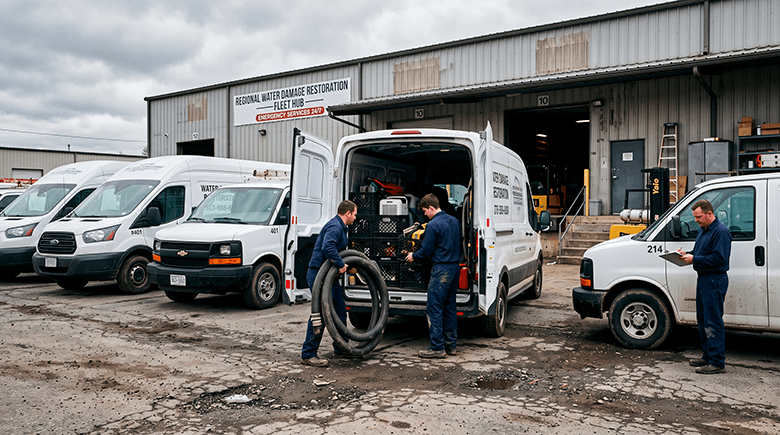 Our localized dispatch hubs maintain a continuous readiness network of fully stocked technical vehicles to guarantee rapid response deployment.
Immutable Call Auditing and Insurance Claims Alignment
Managing an emergency water loss claim with major national insurance adjusters requires precise documentation and clear timeline verification. Claims adjusters review structural flooding cases closely, often requiring documented proof of immediate mitigation to approve full financial payouts. To protect property owners, our central call routing network automatically logs every incoming emergency inquiry with an unalterable chronological timestamp, verifying exactly when extraction help was requested.
Once on-site, dispatched warehouse crews compile comprehensive tracking files detailing the entire restoration project history. They maintain exhaustive dry logs, including precise moisture mapping profiles, infrared heat maps, and daily psychrometric charts tracking relative humidity changes. Providing this audit-ready technical evidence package proves the building was dried to certified industry standards, giving insurance adjusters the clear facts needed to process claims smoothly and eliminate costly coverage disputes.